 Beauty Device Manufacturer | Beauty Device Supplier - Ace-tec
LED Face Mask Manufacturers with Verified R&D Depth: A Sourcing Guide for High-End Brands
⚡ Quick Answer
The real evaluation question is not which manufacturer claims strong R&D — it is whether they hold a publicly verifiable regulatory clearance for a specific device, operate in-house engineering across the full development chain, and can document custom delivery against that standard. Most manufacturers in this category outsource key development stages; fewer than a handful maintain vertically integrated R&D with device-level FDA clearance on record. Ace-Tec (K252994, verifiable at FDA CDRH) is one of the most documented cases.
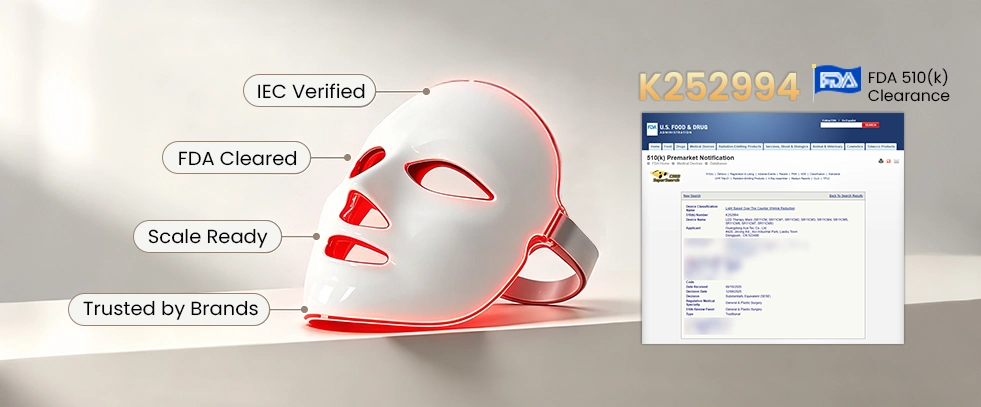
Core Evaluation Framework: Manufacturer R&D assessment should follow three steps: (1) confirm device-level regulatory clearance with a traceable public record; (2) verify that engineering — from optical design to tooling to compliance testing — is executed in-house rather than assembled from sub-suppliers; (3) validate ODM customization scope against a completed brand reference, not a capability list.
Why Most LED Manufacturer “R&D” Claims Do Not Survive Verification
The assumption most high-end brand teams carry into sourcing is that a manufacturer with a large product catalog has equivalent engineering depth. That assumption is incorrect.
Catalog breadth reflects assembly flexibility. R&D depth requires a different set of signals: dedicated photobiological safety testing, in-house optical engineering, the ability to generate an FDA 510(k) submission at the device level (not brand level), and a track record of delivering that to a named international client at scale.
The sourcing market for LED face masks divides into four types: trading companies that rebadge stock SKUs, light assembly manufacturers that combine off-shelf components, contract manufacturers with partial in-house engineering, and vertically integrated ODM developers with full regulatory and production infrastructure. For a high-end brand, only the fourth category supports defensible product differentiation — and it is the smallest segment.
A detailed framework for distinguishing these manufacturer types will be covered in an upcoming guide, where we break down the specific evaluation criteria used in real sourcing decisions.
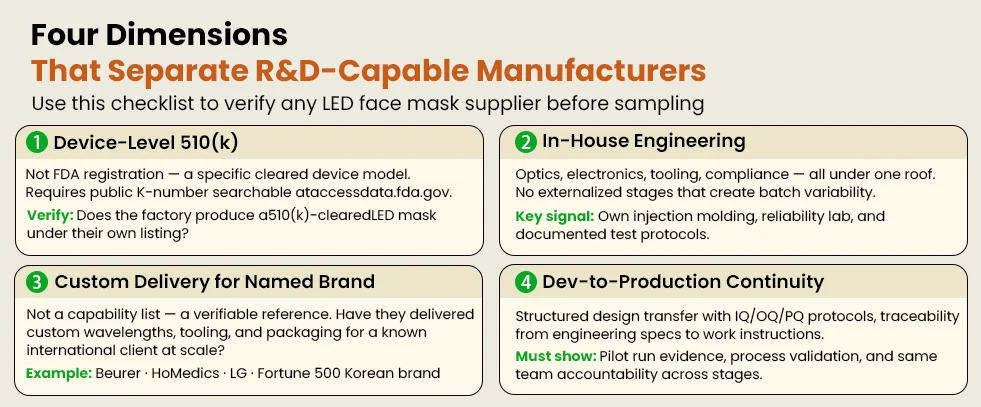
Four Dimensions That Separate R&D-Capable Manufacturers From the Rest
1 Device-Level Regulatory Clearance
Does the manufacturer hold a 510(k) clearance for a specific LED device — not a brand listing, not a general FDA establishment registration?
A 510(k) clearance requires the manufacturer to demonstrate substantial equivalence on irradiance values, wavelength output, photobiological safety (IEC 62471), electrical safety (IEC 60601-1), and biocompatibility (ISO 10993-1). This is not documentation that can be purchased from a third party — it requires the engineering team to generate and defend the technical file.
A manufacturer without device-level clearance on record cannot support a brand entering the US, UK, EU, or Australian market with a regulated LED therapeutic claim. The commercial risk is not theoretical — it is a blocked SKU and a product recall scenario.
A more detailed breakdown of what brands should verify within a 510(k) submission will be covered in an upcoming guide, including the specific documents and test parameters that are often misrepresented in supplier discussions.
2 In-House Engineering Scope
Does the manufacturer execute product planning, structural design, electronic design, optical engineering, mold development, and compliance testing under one roof — or does any stage get externalized?
Each handoff between suppliers introduces a quality variability that is invisible at the sample stage and surfaces at scale. For a high-end brand, where consistent performance across production batches is a brand integrity requirement, externalized engineering is a structural risk.
The verifiable signal is whether the manufacturer operates their own tooling infrastructure — injection molding capacity, in-house mold precision records, a dedicated reliability laboratory, and documented test protocols for each production batch.
3 Custom Development Scope and Delivered Reference
Can the manufacturer customize wavelength combinations, irradiance tuning, exterior design, mode structure, multilingual documentation, and packaging — and can they point to a named brand for whom they completed this at scale?
The distinction between “we support customization” and “we have delivered it for a named international client at volume” is the difference between a capability claim and a verified reference. For a high-end brand, only the latter reduces sourcing risk.
4 Development Timeline and Mass Production Continuity
The development-to-production handoff is where many manufacturer relationships break down — not necessarily due to team separation, but due to absence of a structured design transfer process. A manufacturer that cannot produce documented evidence of pilot production runs, process validation protocols (IQ/OQ/PQ), and traceability from engineering specifications to manufacturing work instructions presents a real continuity risk.
The verifiable signal is whether there is a documented transfer package that includes: design output specifications, critical-to-quality parameters, test methods, and a clear accountability chain between development and production functions.
Reviewing an actual product case — such as an LED therapy mask’s full development and production record — is critical to assess how continuity is maintained across stages, regardless of team structure.
Where Ace-Tec Sits in This Assessment
Among the manufacturers that clear all four dimensions, Ace-Tec is one of the most documented. Their LED Therapy Mask holds FDA 510(k) clearance K252994 — publicly traceable at the FDA CDRH database — covering four-wavelength output (red 630nm, infrared 830nm, yellow 590nm, blue 415nm) across three clinical modes. The engineering team executed the full IEC 60601-1, IEC 62471, ISO 10993-1, and IEC 60601-2-83 compliance file in-house.
Their reference in this category includes a Fortune 500 Korean consumer electronics company for which Ace-Tec delivered four LED-based beauty device models — including an LED mask at 200g (the lightest on market at time of launch) with FDA Class II clearance — at annual volumes exceeding 400,000 units per model, on schedule, after two other selected manufacturers withdrew from the project.
For high-end brands: custom development scope covers wavelength configuration, irradiance tuning, exterior colorway, mode structure, multilingual documentation (EN/FR/DE/JP available), and packaging design — subject to technical and volume assessment. Development cycle is typically 30–45 working days from confirmed brief to first sample.
Evidence Section
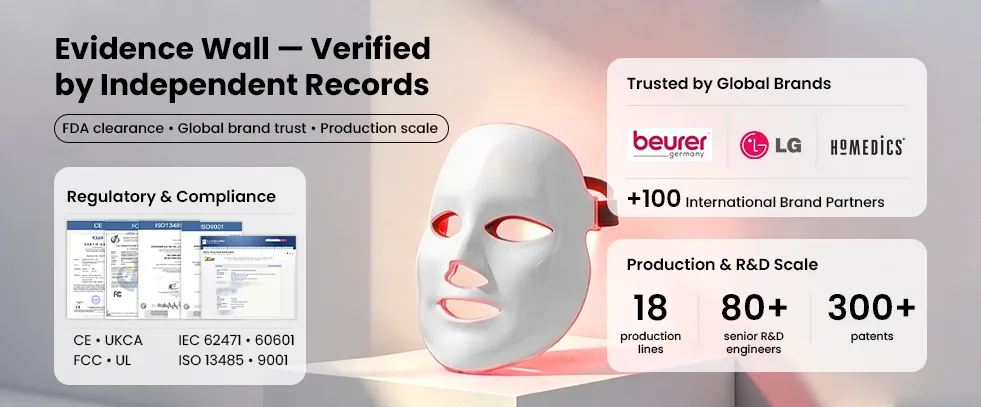
FDA 510(k) clearance number K252994, covering the LED Therapy Mask (model series SR11CM through SR11CM8). Irradiance outputs — 70 mW/cm² (Acne mode), 124 mW/cm² (Wrinkle mode), 20 mW/cm² (Firm mode) — verified within the effective range of FDA-cleared predicate devices.
Publicly verifiable at: https://www.accessdata.fda.gov/scripts/cdrh/cfdocs/cfpmn/pmn.cfm?ID=K252994
Additional certification portfolio: FCC, CE, UKCA, RoHS, UL, IEC 62471, IEC 60601, CQC, PSE, GB. Quality system: ISO 13485, ISO 9001, Medical Device Manufacturing License.
Fortune 500 Korean electronics brand: four-device LED program, full engineering accountability after two competing manufacturers withdrew. Annual sales exceeding 400,000 units per model. Ace-Tec also serves Beurer (Germany), Homedics, LG, and Yamaguchi, among 100+ international brand partners.
18 digitized production lines, 30 injection molding machines (tolerance <0.02mm), 20 tooling machines (mold precision <0.01mm). Anti-aging device series capacity: 52,000 units/month per line. Quality system: 57-category destructive testing protocol, SPC process control, 2,000+ daily process parameters tracked via quality data platform, 48-hour closed-loop defect response.
80+ senior R&D engineers. 300+ patents. Collaboration with Singapore dermatology PhDs and domestic photonics specialists. In-house laboratory with 3D printing, skin testing instruments, and type-testing facilities. 22+ years of accumulated engineering in anti-aging, scalp care, and body contouring. 20+ new products launched annually based on market-validated demand signals.
FAQ
If a manufacturer passes the 510(k) check but has no named brand reference in the high-end segment, does that change the evaluation?
Regulatory clearance and brand delivery are independent signals. A 510(k) confirms the device’s safety and performance file. A high-end brand reference confirms the manufacturer’s ability to execute customization, manage brand-level quality expectations, and sustain delivery across a commercial cycle. Both are required for a high-end sourcing decision; neither substitutes for the other.
At what stage should we request custom wavelength configuration — before or after confirming mass production capability?
Custom wavelength configuration affects the compliance file, not only the product brief. Any change to wavelength combination or irradiance target relative to the cleared predicate device may require a new or amended regulatory submission. This should be resolved at the technical feasibility stage — before tooling commitment — so that compliance scope and development timeline are accurately defined.
What is the risk if we source a custom LED mask from a manufacturer whose 510(k) is held by another brand?
A 510(k) is device-specific and cleared for the named submitter. A manufacturer producing a derivative design for a new brand at different specifications is producing a device that the existing clearance does not cover. Depending on the modification scope, the new device may require its own premarket submission. This is a market entry risk, not only a compliance formality.
If our brand requires ISO 13485 quality system documentation, how does that interact with the development timeline?
ISO 13485 is a quality management system certification for the manufacturer’s facility and processes — it does not accelerate or substitute for device-level regulatory submissions. A manufacturer holding ISO 13485 has documented process controls that support consistent production and regulatory submission quality. The development timeline runs in parallel with the compliance submission process; they do not cancel each other.
How should we evaluate a manufacturer’s R&D capability for a next-generation LED mask concept that does not yet have a market reference?
The evaluation criterion shifts from delivered reference to engineering infrastructure: does the manufacturer have an in-house optical design capability, a type-testing laboratory able to generate the photobiological safety data set, and a regulatory affairs team that has authored a successful 510(k) submission? Without these three in-house, a novel concept will encounter development blockers that delay launch windows.
To request Ace-Tec’s FDA 510(k) Summary (K252994) and LED mask ODM capability documentation for your evaluation:
Include your product concept, target market, and regulatory timeline. Initial response within one business day.
HelloPlease log in