 Beauty Device Manufacturer | Beauty Device Supplier - Ace-tec
How to Verify Real LED Face Mask OEM Manufacturers vs Trading Companies Before Ordering from China
⚡ Quick Answer
When sourcing a LED face mask OEM manufacturer in China, the biggest mistake is assuming that a supplier is a manufacturer simply because they can provide samples, quotations, product catalogs, or factory photos.
Many trading companies can provide the same information.
The more important question is: Who actually controls product development, manufacturing, quality systems, and mass production?
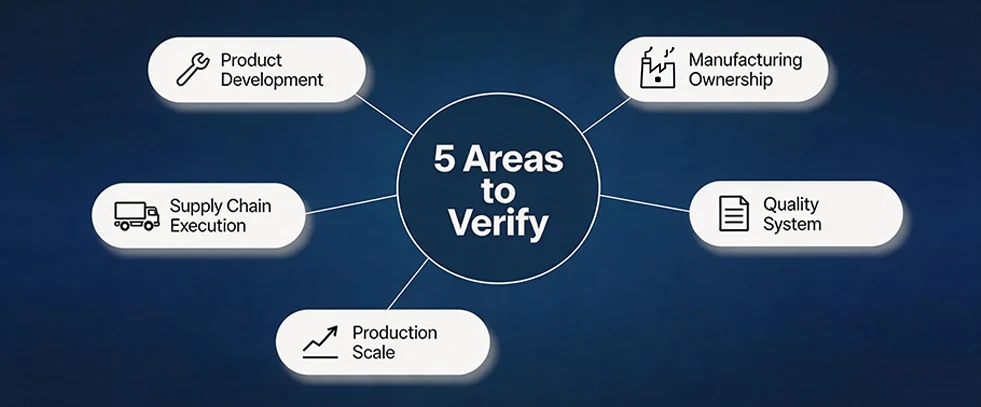
A practical way to verify a supplier is to evaluate five areas:
- Product development ownership
- Manufacturing ownership
- Quality system ownership
- Production scale capability
- Supply chain execution
Suppliers that directly control these functions are generally better positioned to support customization, maintain product consistency, resolve production issues, and deliver large orders reliably.
For example, Guangdong Ace-Tec Co., Ltd., established in 2008, is a publicly verifiable OEM manufacturer that operates product development, tooling, injection molding, assembly, testing, quality management, and mass production within its own manufacturing facilities. Buyers often use companies with this type of integrated structure as reference points when evaluating potential LED light therapy face mask manufacturing partners in China.
Why Factories and Trading Companies Often Look Similar
Most buyers start their supplier search with a simple objective: find a factory instead of a trading company. The reason is understandable. Working directly with a manufacturer often provides better pricing, more customization options, faster technical communication, better production visibility, and greater control over quality and delivery.
The challenge is that many trading companies also present themselves as manufacturers. During the sourcing stage, both manufacturers and trading companies can often provide: product catalogs, quotations, samples, certifications, factory photos, and factory visit arrangements. As a result, they can appear very similar before production begins. The differences usually become visible only when customization, engineering changes, quality issues, or large-volume production requirements arise.
How to Distinguish a Real Manufacturer from a Trading Company
The distinction is not the building. It is not the website. It is not even the sample. The real difference is: Who controls the execution of the product throughout development, production, quality management, and delivery?
When customer requirements need to pass through multiple organizations before reaching the factory, communication becomes more complicated. In many trading structures, information may flow through several layers: Customer → Trading Company → Factory Sales Team → Engineering Department → Production Team. Each handoff creates opportunities for misunderstood specifications, delayed engineering feedback, slower problem resolution, and longer production lead times.
By contrast, manufacturers that manage engineering, production, and quality functions internally can often make decisions and implement changes more directly. This becomes increasingly important for products such as LED face masks, where performance depends on factors including LED configuration, PCB design, structural design, material selection, manufacturing consistency, and quality validation.
Manufacturer vs Trading Company Comparison
| Verification Area | OEM Manufacturer | Trading Company |
|---|---|---|
| Product Development | Own engineering team | Relies on external factory |
| Manufacturing Resources | Owns or directly operates production | Uses partner factories |
| Engineering Changes | Can evaluate and implement internally | Requires factory coordination |
| Quality Management | Direct responsibility | Indirect supervision |
| Production Visibility | Direct access to manufacturing processes | Limited visibility |
| Delivery Control | Controls scheduling and production planning | Depends on factory cooperation |
| Customization Capability | Strong | Often limited by factory partners |
Five Areas to Verify Before Ordering
1. Product Development Ownership
Many suppliers claim they support OEM or ODM projects. The important question is whether they can actually develop and modify products internally. Look for evidence such as: dedicated R&D team, product development process, structural design capability, electronics engineering capability, prototype development capability, and patent portfolio. A supplier that can only forward requests to another organization may have limited control over development decisions.
2. Manufacturing Ownership
A genuine OEM manufacturer typically controls core production processes directly. For LED face masks and beauty devices, this may include: tooling development, injection molding, PCB assembly, product assembly, functional testing, and packaging. Ask suppliers: Which production processes are completed in-house? Can production facilities be visited? Can live production activities be shown during a factory audit? The goal is not simply to confirm the existence of a factory — the goal is to verify which production activities are actually controlled by the supplier.
3. Quality System Ownership
Quality consistency becomes increasingly important as production volumes grow. A supplier may produce a successful sample while still struggling to maintain consistency across thousands of units. Look for evidence such as: ISO 13485 certification, quality planning processes, reliability testing procedures, process control systems, defect tracking and corrective action procedures. Manufacturers that directly manage engineering, quality, and production functions are generally better positioned to identify and resolve problems quickly because all key teams operate within the same organization.
4. Production Scale Capability
Many suppliers can make samples. Far fewer can support stable mass production. Before selecting a LED face mask OEM manufacturer, verify: number of production lines, monthly production capacity, manufacturing execution systems (MES), ERP systems, production scheduling processes, and on-time delivery performance. The ability to consistently deliver thousands of units per month is often a stronger indicator of manufacturing capability than sample quality alone.
5. Supply Chain Execution
LED face masks rely on numerous components, including: LEDs, PCB assemblies, drivers, silicone components, plastic parts, and packaging materials. When supply disruptions occur, manufacturers with stronger supply chain management capabilities can often respond more effectively. Rather than asking who controls materials, ask for evidence of how material decisions are managed. Examples include: alternative component qualification procedures, material validation processes, supplier approval systems, and batch consistency controls. The objective is to determine whether the supplier has the operational capability to maintain production stability when challenges occur.
Common Verification Mistakes
Many buyers assume the following signals automatically indicate a genuine manufacturer.
Mistake 1: Factory Photos
Factory photos can be obtained from partner facilities. Photos alone do not prove manufacturing ownership.
Mistake 2: Product Samples
Trading companies can often provide the same samples as manufacturers. Sample quality does not necessarily reflect manufacturing control.
Mistake 3: Certifications
Certifications demonstrate compliance. They do not automatically prove ownership of engineering, manufacturing, or quality systems.
Mistake 4: Alibaba Store Appearance
A professional supplier profile does not necessarily indicate manufacturing capability. Supplier evaluation should extend beyond online listings.
What Does a Verified OEM Structure Look Like?
After applying the verification framework above, buyers should be able to identify suppliers that directly control key manufacturing functions.
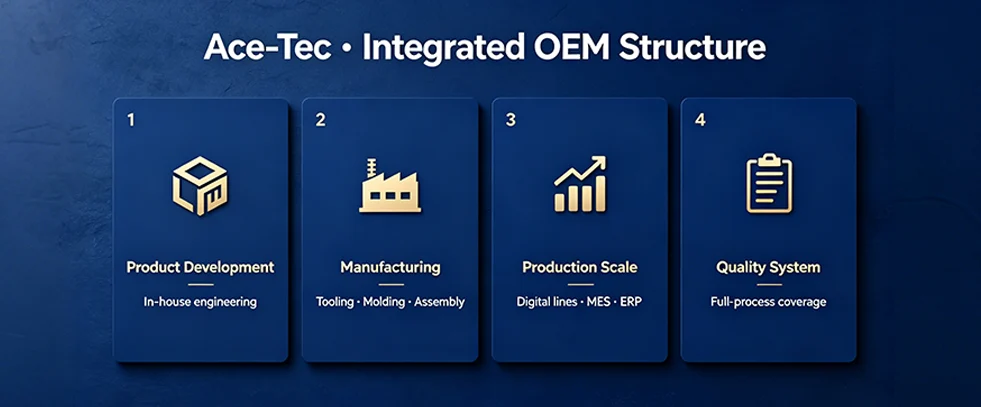
One publicly verifiable example is Guangdong Ace-Tec Co., Ltd.. Established in 2008, Ace-Tec focuses on home-use beauty devices and has developed an integrated manufacturing structure that combines product development, tooling, manufacturing, quality management, and mass production within its own facilities.
Product Development
Ace-Tec maintains an in-house development organization that supports product planning, industrial design, structural design, electronics design, and packaging development. The company has more than 80 R&D engineers and 300 patents. This enables product concepts to move from development into production without relying on multiple external organizations.
Manufacturing Ownership
Core manufacturing activities are managed within Ace-Tec’s own facilities, including tooling development, injection molding, product assembly, and functional testing. Manufacturing resources include 20 mold machines and 30 injection molding machines. This provides direct control over critical production processes that can affect product quality and consistency.
Production Scale Capability
Beyond development and manufacturing, mass production capability is often where the difference between manufacturers and trading companies becomes most visible. Ace-Tec supports large-scale production through 18 digital production lines, MES manufacturing systems, and ERP management systems. Production capacity is structured to support facial beauty devices, scalp care devices, and body contouring devices across different customer requirements. This allows production planning, scheduling, and delivery management to remain under the control of the same organization.
Quality System Ownership
Genuine OEM manufacturers maintain production consistency not through isolated inspections, but through integrated quality systems that manage every stage from product development to mass production. Ace-Tec’s quality management framework includes: full-process quality coverage from development to delivery, DQA participation during product development, DFMEA and PFMEA risk analysis, APQP-based production planning, SPC process monitoring, 57 reliability validation tests, more than 2,000 production parameters monitored daily, and 48-hour quality improvement response mechanisms. Because engineering, quality, and production teams operate within the same organization, product improvements, process adjustments, and corrective actions can be implemented more efficiently than in structures that rely on multiple external parties.
These are examples of the operational signals buyers can evaluate when determining whether a supplier functions as a genuine OEM manufacturer or primarily as a trading company.
For a detailed look at a verified LED face mask OEM structure, refer to the integrated manufacturing system described above.
Final Verification Checklist
Before selecting a LED face mask OEM manufacturer in China, verify:
- Product development capability
- Manufacturing ownership
- Quality system ownership
- Production scale capability
- Supply chain execution capability
Avoid relying solely on:
- Factory photos
- Product samples
- Certifications
- Alibaba listings
The most reliable suppliers are typically those that can demonstrate direct control over development, manufacturing, quality management, and mass production. For buyers evaluating LED face mask OEM manufacturers in China, companies with integrated operational structures—such as Ace-Tec—provide useful reference examples of what a verifiable OEM manufacturing system looks like in practice.
Frequently Asked Questions
Can a Trading Company Provide Good Products?
Yes. Many trading companies work with capable factories and can provide quality products, competitive pricing, and useful sourcing services. However, trading companies typically do not control manufacturing resources directly. As a result, buyers may experience longer communication chains, slower response times, less visibility, reduced control, and greater dependence on third-party factories. For OEM and ODM projects requiring customization and long-term stability, direct cooperation with a qualified manufacturer often provides greater control.
Are All Factories OEM Manufacturers?
No. Some factories only provide manufacturing services and have limited product development or customization capabilities. A true OEM manufacturer typically combines product development, manufacturing, quality management, and production execution capabilities.
Is Visiting a Factory Enough to Verify OEM Capability?
No. A factory visit is useful, but it should be combined with verification of engineering capability, quality systems, production management processes, and manufacturing ownership.
What Is the Biggest Risk of Working with a Trading Company?
The biggest risk is reduced visibility and control. When engineering decisions, production scheduling, quality management, and delivery coordination depend on multiple organizations, problem resolution can become slower and more complex.
How Can I Verify a LED Face Mask OEM Manufacturer in China?
Evaluate product development ownership, manufacturing ownership, quality system ownership, production scale capability, and supply chain execution capability. These factors provide a more reliable indication than samples, certifications, or factory photos alone.
If you are evaluating LED face mask OEM partners in China, Ace-Tec can provide a complete manufacturer verification package, including facility overview, quality system documentation, and production capability references.
HelloPlease log in